
Money stress isn’t just about numbers. It gets into your body. Your shoulders tighten when you think about bills. Your stomach drops when someone says “bank account.”
A lot of people want money “ASAP,” but if you asked them for real targets, they’d have nothing clear. Their goal is just to “get by,” pay taxes, and hope the overdraft fees slow down.
That’s not how to set money goals. That’s how to stay stuck.
You are not here to stay stuck.
Your mind, your self-image, and your daily actions are shaping your bank account right now. When you learn how to set money goals the right way, you stop letting your bank balance tell you who you are. When you learn how to set money goals the right way, you also learn how to shift your money mindset so your bank balance stops telling you who you are. You start using your mind to write a new story.
You don’t need to be a finance expert. You don’t need a rich background. You just need a fresh decision, a clean mental slate, and a simple process you actually follow.
Let’s start with the slate.
Delete Last Year: The First Step in How to Set Money Goals
Here’s a hard question: Does your thinking control your bank account, or does your bank account control your thinking?
Most people don’t even have to guess. The moment they think about money, their mind pulls up:
The overdrafts from yesterday
The credit cards maxed out
The $7,000, $11,000, or $20,000 of debt
The fees that keep hitting again and again
If that’s what flashes through your mind instantly, your past is in charge. Your bank account is telling your brain what to think.

Before you can learn how to set money goals, you need to press delete on last year’s identity.
That doesn’t mean you pretend those numbers don’t exist. It means you stop calling them “who I am.”
You are not “broke.” You are not “bad with money.” You are not “the one who never gets ahead.”
Those are old patterns, wired in by repetition and emotion.
Right here, say something different:
“From this day forward, I’m attracting fantastic wealth.”
“From this day forward, I lend and do not borrow.”
“I have a positive relationship with money.”
“My savings are growing. My investments are growing.”
“I am the controller of my financial destiny.”
You’re flipping the switch from “money over mind” to “mind over money.”
You can’t set powerful money goals while staring at last year’s mistakes like they’re carved in stone. Deleting the old story is the first real step in how to set money goals that belong to the person you’re becoming, not the person you used to be.Reprogram Your Self-Image Before You Set Money Goals
Most people try to change their money without changing their self-image. It doesn’t work.
If, deep down, you still see yourself as “broke,” “bad with money,” or “the one who never gets ahead,” any new goal will feel fake. You’ll set a money goal, but your nervous system will whisper, “That’s not you.”
So you’ll procrastinate. You’ll avoid looking at your accounts. You’ll “forget” to follow through. And then you’ll use that as proof: “See? I knew I couldn’t do it.”
This is why your self-image comes before your strategies.
Close your eyes for a moment and picture a different version of you:
You log into your bank account and feel proud, not scared.
You shake hands with a new client or employer.
You celebrate a raise, a new contract, or a new business win with friends or family.
You pay a bill easily and still have money left over.
Let yourself feel that version of you as real. Let it be normal, not a fantasy.
Use simple affirmations to start rewiring your identity:
“I am developing a powerful money mindset.”
“I’m learning how to set money goals and follow through.”
“I am worthy of having more than enough.”
Every time you repeat these and feel them, you are learning how to reprogram your subconscious mind to accept a new normal. The more often you do this, the less your old story will run the show.
When your self-image shifts, your actions change. And when your actions change, your income follows.
Focus on High-Income Activities: The Missing Step in How to Set Money Goals
There’s a big trap almost everyone falls into: confusing busy work with income-producing work.
You can spend all day on:
Emails
Organizing files
Clicking around “researching”
Little tasks that make you feel productive
And at the end of the month, your income hasn’t moved.
That’s because those aren’t high-income tasks. They don’t push the needle.

If you really want to live what you write when you practice how to set money goals, you have to connect your goals to actions that actually create money.
Ask yourself:
What would directly increase my income?
What would help me get a raise or promotion?
What would help me get better clients or more customers?
What skills would make me more valuable?
High-income tasks might look like:
Asking your boss for more responsibility and a raise
Applying for better-paying jobs instead of just scrolling them
Making sales calls or sending offers
Following up with warm leads
Creating a simple offer or service and telling people about it
Spending an hour learning a skill that will earn you more later
Here’s a quick exercise straight from the energy of the transcript:
Open your phone notes or grab a 3x5 card.
Title it: High-Income Tasks.
List 3–5 activities that, if you did them most days, would likely raise your income.
This becomes your make money list, not just a to-do list.
When you know how to set money goals, you stop filling your day with “busy” and start filling it with “paid.”Take Responsibility for Your Financial Freedom
There’s a moment where the excuses have to end. There’s a moment when you have to take responsibility for your finances and stop waiting for life to rescue you.
No more waiting on the government. No more hoping the economy saves you. No more “I’ll figure it out someday.”
That doesn’t mean blame yourself for everything. It means you accept that no one cares about your financial future as much as you do. That’s actually good news, because it puts the power back in your hands.
One of the biggest blocks to how to set money goals is something called anticipatory anxiety. It’s the fear of what might happen:
“What if I set a big goal and I fail?”
“What if I write it down and nothing changes?”
“What if I try and everyone sees me fall on my face?”
So you protect yourself by not aiming at anything. You never write down the numbers. You never pick a target. You say, “It’s not that important, at least I’m happy,” while secretly stressing about bills at night.
Not choosing is still a choice. It’s just a choice to stay where you are.
Money, done honestly, is actually a spiritual practice. To earn more in a clean way, you have to:
Strengthen your integrity
Become more organized
Communicate better
Grow your confidence
Show up when it’s uncomfortable

These skills make you a better partner, friend, parent, and creator. Money becomes the arena where your character evolves.
When you take full responsibility, how to set money goals stops being a pressure game and becomes a growth game.Why Learning How to Set Money Goals Unlocks Your Hidden Potential
Something powerful happens when you write down a clear money goal.
You send a signal to your brain: This matters. Pay attention to anything that helps make this real.
Your mind starts to look for ideas, people, and opportunities that match your intention. It’s like turning on a mental GPS. Before, it was drifting. Now, it has a destination.
This is one of the reasons how to set money goals is such a big deal. It doesn’t just organize your finances. It activates parts of you that were asleep:
Creativity
Confidence
Problem-solving
Resilience
In simple terms, your brain is always changing and wiring itself based on what you focus on. When you keep feeding it “I’m broke and stuck,” it builds more of that pattern. When you feed it, “I’m increasing my income and building wealth,” and you back that with action, it starts to build a new pattern.
You don’t have to understand all the science. Just know this:
Clear goals + repeated focus + aligned action = a new financial reality over time.
You begin to see yourself differently. You begin to show up differently. And life responds to the new you.
The Exact Process: How to Set Money Goals That Actually Work
Let’s make this simple and practical. Here is a step-by-step way to practice how to set money goals so they actually work.
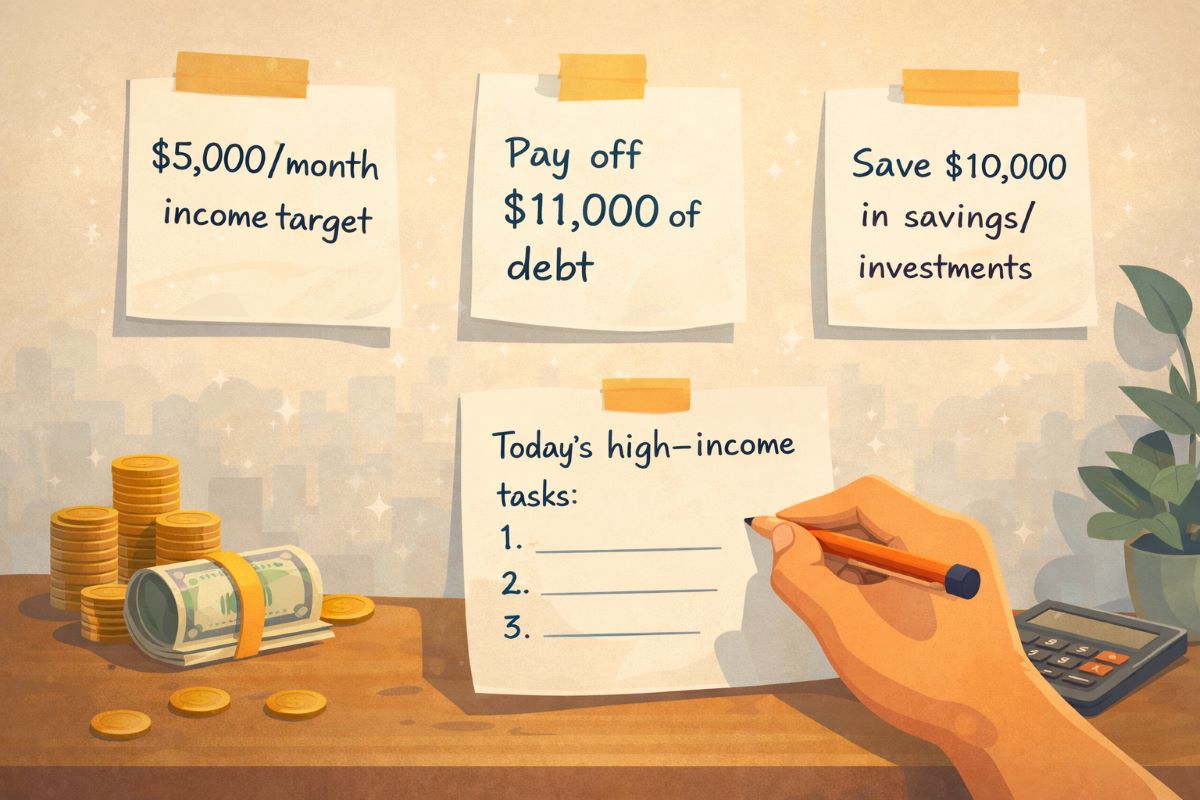
Step 1: Choose Your Main Money Targets
Pick 3–4 clear financial goals for the next 12 months. For example:
A specific monthly income (e.g., $5,000/month)
A total amount of debt to pay off
A savings amount you want to have in the bank
An investment amount you want to start or grow
One simple way to make that target feel real is to break your annual income into monthly income so you can see what the year is actually asking of you. Be specific. “Make more money” is not a goal. “Earn $5,000/month by December” is.
Step 2: Write Them Down on Paper
Don’t keep it in your head. There is real power in writing things by hand.
On a piece of paper, write:
“By [date], I earn $____ per month.”
“By [date], I have paid off $____ of debt.”
“By [date], I have $____ in savings/investments.”
You are telling your mind, “This is where we’re going.”
Step 3: Think in Terms of Net Worth
If you have debt, include that in your vision.
For example: If you’re $11,000 in debt, you might set a goal to both pay that off and have $10,000 saved. That’s a $21,000 swing in your net worth over the year.
This makes how to set money goals feel exciting, not depressing. You’re not only getting back to zero—you’re building a positive future.
Step 4: Put Your Goals Where You See Them Daily
Tape that paper to your bathroom mirror or your fridge. Put a copy by your bed.
You want your nervous system to get used to seeing these numbers again and again. At first they may trigger doubt. Over time they become normal.
Step 5: Read Them Every Morning and Night
Take one or two minutes to read your goals out loud when you wake up and before you go to sleep.
As you read them:
Imagine how it feels to already be that person.
Picture yourself checking your bank account and seeing those numbers.
Feel grateful in advance.
You are “hypnotizing” your brain with a new reality.
Step 6: Link Your Goals to Daily High-Income Tasks
Right under your written goals, add:
“Today, my top 3 high-income tasks are:
___________________________________________________________”
Final Thoughts: How to Set Money Goals and Change Your Life
The truth is, you are more powerful than your current bank balance.
You’ve carried old stories, past mistakes, and other people’s beliefs about money for long enough. Now you know how to set money goals in a way that honors who you really are and where you’re going.
You’ve seen that:
You must delete last year’s failures from your identity.
Reprogramming your self-image makes wealth feel natural, not impossible.
High-income-producing activities matter more than staying “busy.”
Taking responsibility for your finances is an act of courage and self-love.
Clear written goals wake up your hidden potential.
A simple daily routine of reading and acting on your goals can transform your life over the next 12 months.
You don’t have to be perfect. You just have to begin.
Today, grab a piece of paper. Write down three clear money goals. Put them where you’ll see them. Read them out loud. Take one brave action that moves you closer.
You’re not just learning how to set money goals. You’re deciding that your future will be different from your past.
That decision is where everything starts to change.